
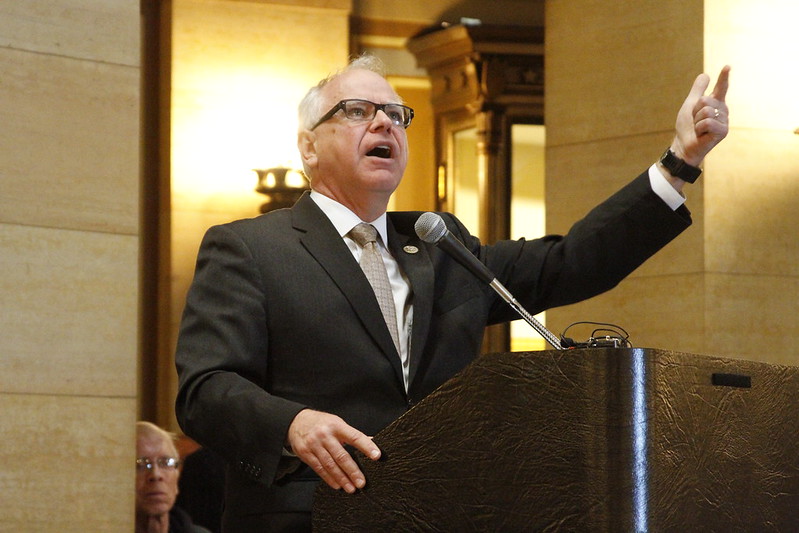
US Vice President Kamala Harris has chosen Gov. Tim Walz of Minnesota as her running mate.
Governor Tim Walz has notably reshaped Minnesota’s tax landscape, setting the state apart from national norms with several distinctive policy changes and a focus on tax increases.
Here’s a summary of the key developments under his administration:
SURTAX ON INVESTMENT INCOME
- Minnesota is unique in imposing a surtax on long-term capital gains and other net investment income for high earners.
- This contrasts with the majority of states, which either tax long-term capital gains at ordinary income rates or provide preferential rates.
REVISIONS TO DEDUCTIONS
- Walz enacted legislation to partially phase out the benefits of standard and itemized deductions for high-income individuals.
- A drafting error in this legislation was later corrected to prevent an unintended $350 million tax increase for all taxpayers.
EXPANSION OF CORPORATE INCOME TAX
- The administration expanded the corporate income tax to include global intangible low-taxed income (GILTI), targeting more international business income.
- This approach is different from most states, including New Jersey, which recently removed GILTI from its tax base. New Jersey, along with California and New York, is one of only three states that have raised major tax rates since 2021.
FAILED PROPOSAL FOR WORLDWIDE COMBINED REPORTING
- A proposed expansion to implement worldwide combined reporting in Minnesota, which would have made it the only state with such a system, narrowly failed in the legislature by a single vote.
CONTEXT OF TAX INCREASES
- These tax increases were implemented despite a substantial $17.6 billion budget surplus, indicating a focus on increasing tax progressivity rather than addressing immediate revenue needs.
TAX RELIEF MEASURES
- Walz’s administration introduced a new child tax credit and a tax exemption for most Social Security income.
- The Social Security income exemption aligns Minnesota’s policy with most other states, while the child tax credit is highly progressive, phasing out at relatively low-income levels. For a two-child household, the credit phases out entirely by a household income of $67,083, below the state’s median household income.
ECONOMIC IMPACT
- Minnesota’s tax stance has reinforced its reputation as a high-tax state. This approach may contribute to the state’s recent lackluster economic performance, with employment growth of just 0.7 percent over the past year, ranking 42nd nationwide.
- The state also experiences significant net outmigration, particularly among high-income households, and ranks 6th in terms of net outflow of income.
- Governor Walz’s tax policies represent a notable departure from broader national trends, which generally favor tax cuts. His focus on tax increases highlights a distinctive approach to state fiscal management.
SOURCES/ RECOMMENDED READ:
