
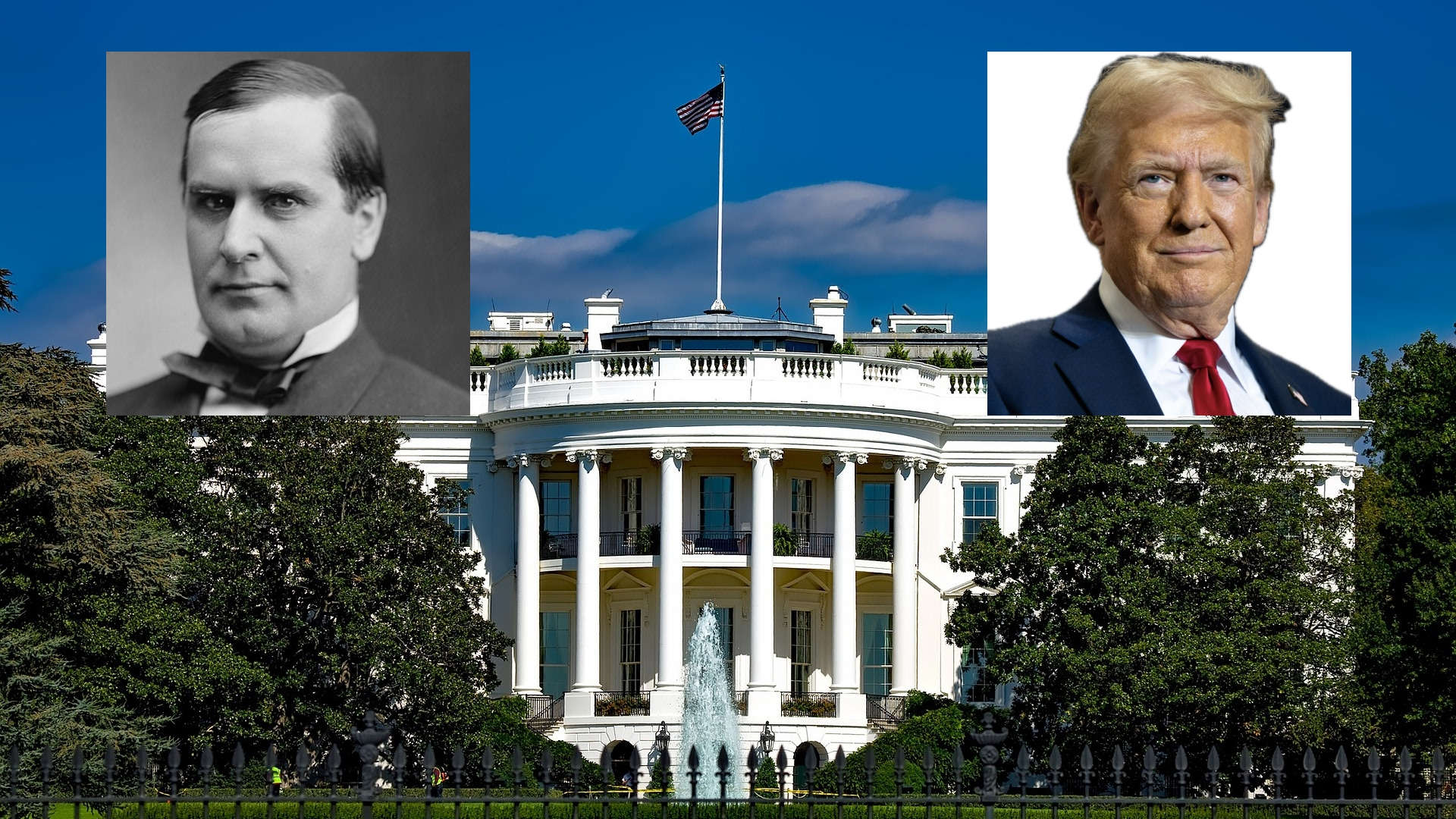
| Image Credits: collage of White House and USA Presidents: William McKinley and Donald Trump
As Donald Trump prepares to assume office as the 47th president of the United States, he’s returning to protectionist tariffs as a core economic tool, drawing inspiration from William McKinley, the 19th-century president who also made high tariffs a central election promise. McKinley’s campaign pledged to shield American industries from foreign competition and foster domestic growth through aggressive tariff policies, a message that resonated with voters eager for economic security. In 1897, upon taking office, McKinley quickly followed through, enacting the Dingley Tariff Act — one of the highest tariffs in U.S. history — with the aim of safeguarding American jobs and industries.
However, as McKinley’s presidency unfolded, he began to see the limitations of such protectionism. Facing retaliatory tariffs and restricted access to foreign markets, he started to question the long-term impact of trade wars on the U.S. economy. His journey from staunch protectionism to advocating trade reciprocity offers critical insights into the double-edged nature of high tariffs.
For Trump and modern-day America, McKinley’s story serves as both inspiration and a cautionary tale — a reminder that while tariffs can protect, they can also isolate and strain the economy. As the new administration moves forward, McKinley’s evolving policies offer a historical perspective on the balance needed in global trade.
EARLY PRESIDENCY AND THE DINGLEY TARIFF ACT
McKinley’s early administration was defined by his commitment to protective tariffs. In 1897, he introduced the Dingley Tariff Act, one of the highest tariffs in U.S. history, aimed at protecting American manufacturers and farmers from foreign competition. This act raised tariffs to historic highs on many imported goods, with some duties reaching up to 57%. It replaced the Wilson-Gorman Tariff Act, which had lowered tariffs in 1894, and marked a significant shift back toward protectionism.
At a time when American industries were growing, McKinley and his supporters believed that high tariffs would stimulate domestic production, create jobs, and ensure economic independence.
However, the policy quickly encountered challenges. Many foreign nations responded with their own tariffs on American goods, limiting market access for U.S. exporters, especially in agriculture. These retaliatory tariffs raised costs for American businesses and consumers, illustrating the unintended consequences of aggressive protectionism.
A SHIFT IN PERSPECTIVE: EMBRACING RECIPROCITY
McKinley’s perspective on tariffs began to shift as the downsides of his policy became evident. The retaliatory measures from other nations led him to reconsider a purely protectionist stance. By the end of the 1890s, the U.S. economy was expanding, and McKinley saw an opportunity to balance protectionism with new opportunities in international markets. This shift became evident in his advocacy for reciprocity agreements — trade deals allowing for mutual tariff reductions on specific goods.
McKinley’s support for these agreements represented a notable departure from strict protectionism. His vision of reciprocity allowed for trade relationships that both protected American industries and opened foreign markets to U.S. products. Through such agreements, McKinley sought to bolster domestic industries while ensuring that American exporters could remain competitive globally.
MCKINLEY’S VISION OF “COMMERCIAL EXPANSION”
By 1901, as McKinley’s second term began, his vision for the U.S. economy had expanded further. He began promoting the idea of “commercial expansion,” advocating for a balance between tariffs high enough to protect key industries and flexible enough to facilitate trade agreements beneficial to U.S. businesses.
In this vision, McKinley acknowledged that the future of American prosperity relied on an interconnected global economy, not isolation. He saw trade as a means to increase American influence and economic stability, positioning the U.S. as a global commercial power. McKinley’s concept of commercial expansion suggested that, while tariffs served a purpose, they needed to be balanced with broader trade goals.
MCKINLEY’S LEGACY AND INFLUENCE ON FUTURE TRADE POLICY
McKinley’s journey from rigid protectionism to a more balanced trade approach influenced American economic policy for decades. Future presidents, including Franklin D. Roosevelt, would expand on McKinley’s principles of reciprocal agreements, adopting policies that promoted American interests while fostering international cooperation.
McKinley’s presidency serves as an early lesson in the complexity of trade policy. His initial enthusiasm for high tariffs illustrated the protectionist stance popular at the time, but his later embrace of trade expansion highlights the importance of adapting to global economic realities. McKinley’s legacy endures as a reminder of the delicate balance required in trade policy — protecting domestic interests while navigating the intricate dynamics of international trade.
